
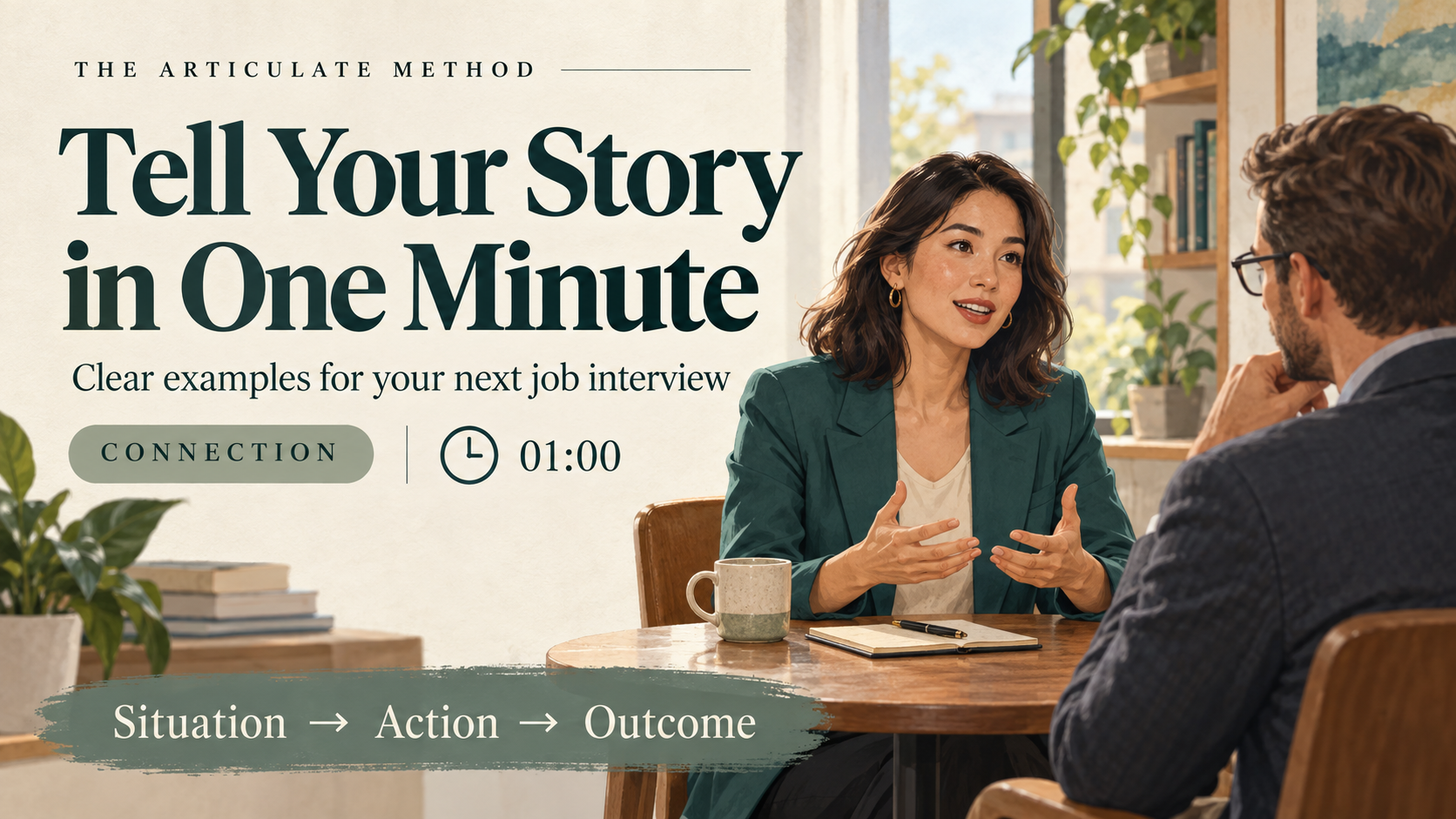
Article written for The Articulate Method website.
To tell a one-minute story in a job interview, choose one relevant experience, explain the situation briefly, describe what you did, and finish with the outcome. Include enough detail for the interviewer to understand your contribution.
One minute is a useful rehearsal target—not a rule for every interview answer. Follow the interviewer’s question and any timing instructions. Some experiences need more explanation.
The aim is to give a complete, truthful example without making the listener search for the point.
What makes a useful interview story?
A useful story answers the question with evidence.
If the interviewer asks about teamwork, the example should show how you worked with others. If they ask about a mistake, it should explain what happened, how you responded, and what you changed.
Look for an experience with:
- A clear situation or problem.
- A responsibility you can explain.
- Actions you personally took.
- An outcome you can describe accurately.
The event does not need to be dramatic. A practical improvement, a difficult conversation, or a well-handled deadline can provide a meaningful example.
You can draw from work, study, volunteering, or other relevant responsibilities. Choose the experience that best answers the question.
A simple structure for a one-minute answer
Use Situation → Action → Outcome as a short planning outline. Make your responsibility clear within the situation.
For a fuller structure, use STAR: Situation, Task, Action, Result. The National Careers Service recommends STAR for organising interview examples and preparing for follow-up questions. National Careers Service: The STAR Method
Try this flexible timing guide:
| Part | Approximate practice time | What to include |
|---|---|---|
| Situation and responsibility | 10–15 seconds | What was happening and what you needed to do. |
| Action | 25–30 seconds | The specific steps you took and important decisions. |
| Outcome and reflection | 15–20 seconds | What happened and, where relevant, what you learned. |
Do not force the answer to fit exact seconds. Give the most space to the information that demonstrates the skill being discussed.
Situation: Give the listener enough context
Start close to the relevant event.
Instead of describing the organisation’s full history, explain the immediate challenge:
“During a student project, two team members were working from different versions of the plan.”
Then clarify your responsibility:
“I was coordinating the final submission.”
Action: Make your contribution visible
Explain what you actually did:
“I brought the changes into one document, checked the differences with both team members, and confirmed which version we would use.”
Specific actions are more useful than labels such as “I showed leadership.”
If the work was collaborative, acknowledge that while distinguishing your contribution.
Outcome: Explain what followed
Finish with the result you can support:
“We submitted one consistent version by the deadline.”
Add a learning point if it helps answer the question:
“I learned to agree on a shared source document at the start of a project.”
Do not add a lesson automatically if the result already completes the answer.
Watch a related lesson on STAR
Watch “STAR Interview Method Explained” by EPM on YouTube.
The video’s published description identifies it as a guide to behavioural interview questions, with STAR answer examples and a preparation process. Its companion article explains the same framework.
Use it alongside this article to think about how a past experience becomes a structured answer. The one-minute timing exercise here is supplementary practice, not a rule attributed to the video.
After watching, ask yourself:
- What context did the listener need?
- Which actions showed the speaker’s contribution?
- What outcome completed the story?
Video credit: EPM.
Three example interview stories
These are fictional examples for learning the structure. Use your own experiences and facts in an interview.
The answers are short enough for approximately one minute of practice at a comfortable pace, though individual speaking times will vary.
Example 1: Improving a process
Question: “Tell me about a time you improved the way something was done.”
“In my customer-support role, shift handover notes were spread across several message threads. I was responsible for passing open cases to the next shift, and it was difficult to see who was following up. I proposed a shared checklist with a case reference, an owner, and a next action. I created a draft, asked two colleagues to test it, and simplified the fields based on their feedback. We used it for a week, and the team reported that outstanding cases were easier to identify. My manager agreed to keep it. I learned that a small process change works better when the people using it help shape it.”
Why it works: The story identifies a specific difficulty, makes the speaker’s actions visible, and reports an outcome without inventing a numerical improvement.
Example 2: Handling a team disagreement
Question: “Tell me about a disagreement you helped resolve.”
“During a group presentation project, we disagreed about whether to include a detailed technical explanation. I was responsible for combining everyone’s sections. One person wanted to demonstrate the research, while another worried that we would exceed the time limit. I suggested checking each section against the assessment brief and timing a rehearsal. The rehearsal showed that we needed to shorten the main talk. I proposed keeping a brief explanation in the presentation and moving the supporting detail to backup slides. The group agreed, and we finished within the allotted time. That experience taught me to bring a disagreement back to a shared requirement.”
Why it works: Both perspectives are represented fairly. The answer shows how the speaker helped the group decide, rather than presenting the disagreement as a personal victory.
Example 3: Learning from a mistake
Question: “Tell me about a mistake and what you learned.”
“While helping organise a volunteer workshop, I sent participants a reminder containing an outdated room number. I had reused an earlier message without checking the booking. When a colleague noticed, I checked the correct location, sent a clearly labelled correction, and arranged for a sign at the original room. I also asked another volunteer to direct anyone who arrived there. We were able to get participants to the correct room before the session started. Afterwards, I added a location check to our reminder checklist. I learned to verify the practical details in a reused message, even when most of its content is still accurate.”
Why it works: The speaker takes responsibility, explains the correction, and identifies a concrete change in practice.
How to shorten a story without losing the evidence
Shorten the background before cutting the actions.
Compare:
“This happened when I was working at a company that had several departments, and we had recently changed some internal processes, which had involved quite a few meetings…”
With:
“After a process change, our team was unclear about who approved customer refunds.”
The second version gets the listener to the relevant problem.
Then review each remaining detail:
- Does it explain the challenge?
- Does it show my responsibility?
- Does it reveal an important action or decision?
- Does it help explain the outcome?
If a detail does none of these, consider leaving it for a follow-up question.
Avoid compressing the story into vague statements:
“I communicated effectively and achieved a good result.”
Keep the evidence:
“I confirmed who could approve the refund, explained the next step to the customer, and followed up when the decision was ready.”
A concise story still needs substance.
How to sound natural
Prepare the sequence rather than memorising every word.
Write a small set of prompts:
Unclear handovers → shared checklist → colleague feedback → adopted by team
Practise telling the story twice using slightly different wording. Keep the facts consistent.
During the interview:
- Listen to the exact question.
- Choose the example that fits.
- Pause briefly if you need to organise it.
- Use straightforward language.
- Stop after the outcome or relevant reflection.
You do not need to announce “Situation,” “Task,” “Action,” and “Result” aloud.
If the interviewer asks a follow-up, answer that question directly. Avoid restarting the entire story.
A five-minute storytelling exercise
Minute 1: Choose one real experience
Select a question such as:
“Tell me about a time you solved a problem.”
Choose an event you remember well enough to discuss accurately.
Minute 2: Write four notes
Record:
- What happened.
- What you were responsible for.
- What you did.
- What happened afterwards.
Use keywords rather than a polished paragraph.
Minute 3: Tell the story aloud
Aim for approximately one minute without rushing.
Optionally record yourself privately. Continue if you hesitate; do not restart after every imperfect phrase.
Minute 4: Review the evidence
Ask:
- Did I answer the question?
- Was my contribution clear?
- Did I spend too long on background?
- Did I explain the outcome accurately?
- Was any sentence repeating an earlier point?
Minute 5: Try again
Make one improvement. Shorten the setup, clarify an action, or strengthen the ending with a more specific fact.
If the story still needs more than a minute, keep the necessary detail. The exercise is meant to improve focus, not force every answer into the same length.
Frequently asked questions
Does every interview story need to last one minute?
No. One minute is a practice target for a focused example. Follow the question, interview format, and any instructions. Complex examples may need longer.
What if I do not have a measurable result?
Describe the outcome you can verify: a completed task, an agreed decision, an adopted process, or specific feedback. Do not invent percentages or financial benefits.
Can I use the same story for different questions?
Sometimes, if it genuinely demonstrates the skill being asked about. Change the emphasis to answer the question, but keep the facts consistent. Prepare several examples so you have options.
What if the outcome was disappointing?
Explain it honestly. Describe your actions, acknowledge relevant limitations, and identify what you learned or changed. Avoid rewriting an unsuccessful outcome as a success.
Can I use an example from education or volunteering?
Yes, when it is relevant to the question. Make the context and your responsibility clear rather than apologising for the setting.
Should I end every story by saying why I am right for the job?
No. A brief connection can help when it is specific and relevant. Often, the example already demonstrates the skill, and the outcome provides a natural finish.
Prepare your next story
Choose one true experience and make three things clear: the situation, your actions, and the outcome.
Visit the Articulate Method Resources library and look for One-Minute Story Structure to organise your example. Use Interview Answer Framework when you want to connect it to a specific question.