
Article written for The Articulate Method website.
How to stop rambling in interview answers
To stop rambling in interview answers, identify what the interviewer is asking, answer it directly, and support your answer with relevant evidence. Finish when you have explained your contribution and its outcome.
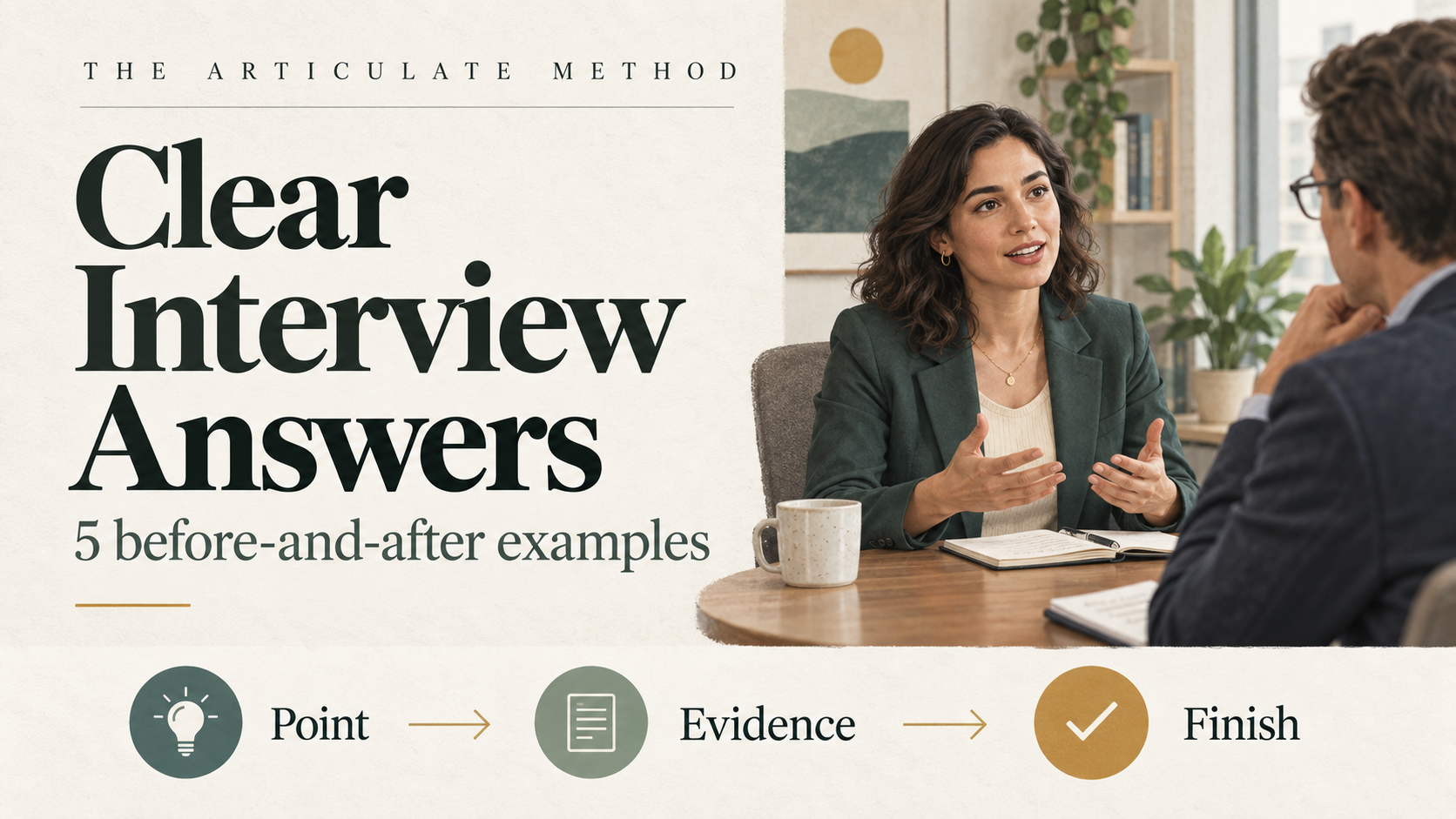
A useful practice structure is Point → Evidence → Finish:
Point: Give your direct answer.
Evidence: Explain a relevant example or reason.
Finish: State the outcome, lesson, or connection to the role.
The goal is to make your experience easy to understand. An answer can be concise and still contain the detail an interviewer needs.
Why interview answers become unfocused
An interview question can bring several experiences to mind at once. You might begin describing one example, remember another, and add background before deciding which experience best answers the question.
Sometimes the difficulty comes at the end. You have answered, but the silence feels unfinished, so you repeat your point or introduce another story.
During practice, look for three patterns:
- The main answer arrives after a long introduction.
- Several examples compete for attention.
- The answer continues after the outcome is clear.
These are useful things to notice—not reasons to judge your intelligence, personality, or suitability for a job.
Choose a structure that fits the question
Point → Evidence → Finish is a flexible practice aid, not a requirement for every answer.
For questions about a past experience, you can organise the evidence using STAR:
Situation: What was happening?
Task: What were you responsible for?
Action: What did you do?
Result: What happened, and what did you learn?
The National Careers Service recommends STAR for structuring examples and preparing for follow-up questions. Oxford’s Careers Service advises giving particular attention to your actions rather than spending most of the answer describing the background.
National Careers Service Oxford Careers Service
A question such as “Why are you interested in this role?” may need a direct explanation supported by relevant experience, rather than a complete STAR story.
Five before-and-after examples
The following examples are fictional. Each revised answer uses the facts already present in the original. Use the structures to organise your own experience; do not adopt someone else’s achievements as your own.
1. “Tell me about yourself.”
Before
“Well, I studied business, and while I was studying I worked in a shop, which was quite busy. After that I moved into customer support. I’ve been there for two years now. I answer customer questions, but I also help update the help articles, which I quite enjoy. I’ve always liked explaining things, and that’s partly why this customer education role looked interesting.”
After
“I’ve spent the last two years in customer support, answering customer questions and helping update our help articles. I particularly enjoy making information easier to understand. That’s what attracted me to this customer education role: the opportunity to focus more directly on helping customers learn.”
What changed
The answer begins with the most relevant current experience. It connects that experience to the role and leaves out earlier history that does not yet add much.
Keep: Relevant experience, a clear interest, and the connection to the opportunity.
Leave for follow-up: A complete education and employment timeline.
2. “Tell me about a time you solved a problem.”
Before
“We had a problem with shift handovers. There were quite a few messages, and people used different places to leave notes. Sometimes a task would get missed. We talked about it in a meeting, and I thought a checklist might help. I made a shared one with a place for the task, the owner, and the status. We tried it for a week, and the team said it was easier to see what still needed doing.”
After
“I helped improve a handover process where tasks were being missed because notes were spread across different places. I created a shared checklist showing each task, its owner, and its status. After a one-week trial, the team reported that it was easier to identify outstanding work.”
What changed
The revised answer makes the problem, personal action, and observed outcome easy to identify. It also preserves the limits of the evidence. The team’s feedback is useful, but it does not establish a measured percentage improvement.
Keep: The problem, what you personally did, and the outcome you can support.
Leave out: Routine meeting history unless it explains an important decision.
3. “How do you handle competing deadlines?”
Before
“It depends on what’s happening, really. Sometimes everything seems urgent. Last month I had a report and a customer guide due on the same day. I checked with my manager because I wasn’t sure which should come first. The report was needed for a decision meeting, so we agreed I should finish that first and move the guide to the following morning. I told the people waiting for the guide, and I delivered both at the agreed times.”
After
“I clarify priorities and communicate any trade-offs early. Last month, a report and a customer guide were due on the same day. I confirmed that the report was needed for a decision meeting, agreed a revised deadline for the guide, and informed the people affected. I delivered both at the agreed times.”
What changed
The opening answers the general question. One example then shows how the approach worked.
Keep: How you prioritised, who needed to be involved, and how you communicated.
Avoid: Claiming that you can always complete every urgent task without changing the plan.
4. “Tell me about a disagreement with a colleague.”
Before
“We were planning some training, and my colleague wanted one long session. I thought shorter sessions would be better, although I understood that scheduling two sessions could be harder. We discussed it a few times. I asked what the main concern was, and it was availability. So I suggested one live session with a separate practice activity afterwards. We agreed on that and used that format.”
After
“A colleague and I disagreed about whether to run one long training session or two shorter ones. I asked about their main concern and learned that scheduling was the difficulty. I proposed one live session followed by a separate practice activity. We agreed on that format because it addressed the scheduling concern while keeping time for practice.”
What changed
The answer focuses on how the disagreement was handled. The colleague’s concern is represented fairly, and the resolution is clear.
Keep: The difference in views, how you understood the other perspective, and the agreed action.
Avoid: Turning the example into a story about proving someone wrong.
5. “Tell me about a mistake you made.”
Before
“I once sent out an internal guide before checking whether all the links worked. I’d checked the wording, but I missed a link to an old folder. Someone told me they couldn’t open it. I corrected the link and sent a note explaining the change. Afterwards I added a link check to my review checklist. I suppose I learned that proofreading isn’t just about spelling.”
After
“I sent an internal guide with a link that readers could not access. When it was reported, I corrected the link and notified the recipients. I then added an access-and-link check to my review checklist. The experience taught me to check whether a document works for the reader, as well as whether the wording is correct.”
What changed
The revised answer acknowledges the mistake, explains the response, and finishes with a specific change in practice.
Keep: Responsibility, corrective action, and what you changed.
Avoid: Hiding the mistake behind a long explanation or claiming it could never happen again.
How much detail should you include?
Keep a detail when it helps explain:
- What the question is asking you to demonstrate.
- Your responsibility.
- A decision you made.
- An action you took.
- The outcome or a relevant limitation.
Consider removing a detail when it repeats information or introduces a side story that does not affect the answer.
Concise does not mean vague. “I communicated well and solved the problem” is short, but it tells the interviewer little about what you did.
“I asked each team member to confirm their outstanding tasks and put the responses into one shared checklist” provides more useful evidence.
How do you know when to stop?
Look for the point where you have answered the question and completed the example.
For an experience question, that may be the result:
“The revised handover was adopted by the team.”
For a learning question, it may be the change you made:
“I now check access permissions before sharing a document.”
For a motivation question, it may be the connection to the role:
“That combination of customer support and teaching is what interests me about this position.”
Pause after the finish. You do not need to add a second example unless the interviewer asks for one or the question requires it.
What to say if you notice yourself rambling
Use a brief reset:
- “The main point is…”
- “Let me focus on what I did.”
- “The outcome was…”
- “To answer your question directly…”
For example:
“Let me focus on what I did. I checked which deadline affected the decision meeting, agreed the revised priority, and informed the people waiting.”
Continue from there. A long apology can become another detour.
Practise without memorising a script
Prepare a small collection of truthful examples from work, study, volunteering, or other relevant responsibilities.
For each one, write a few notes:
- The question or skill it could address.
- The essential context.
- Your actions.
- The outcome.
- What you learned.
Then practise responding to different questions using the same facts where appropriate.
Keep the wording flexible. The question should determine which parts you emphasise.
A five-minute practice exercise
Minute 1: Choose a question.
Pick one question from this article.
Minute 2: Make brief notes.
Write your point, supporting evidence, and finish.
Minute 3: Answer aloud.
Optionally record yourself on your own device. You can use 60–90 seconds as a practice constraint for an experience example, but this is not a universal interview rule.
Minute 4: Review.
Identify one repeated detail, unclear action, or unnecessary introduction.
Minute 5: Try again.
Improve that one element. Do not speed up simply to make the answer shorter.
Follow any timing instructions provided for the actual interview.
Frequently asked questions
Should every interview answer use STAR?
No. STAR is useful for questions asking about a particular experience. Motivation questions, factual questions, technical discussions, and case exercises may need different structures.
What if I do not have a numerical result?
Describe the outcome accurately. A completed handover, an adopted recommendation, or specific feedback may be relevant. Do not invent a percentage or financial benefit.
Can I take a moment before answering?
A brief pause can give you time to select an example. You can say, “Let me choose a relevant example.” If the question is unclear, ask for clarification.
What if the interviewer wants more detail?
Answer the follow-up directly. You do not need to restart the whole story. Explain the action, decision, or result they have asked about.
Prepare your next answer
Choose one real experience and organise it into Point → Evidence → Finish. Say it aloud, check that your contribution is clear, and finish when the question has been answered.
Visit the Articulate Method Resources library and use Interview Answer Framework to prepare and practise your own response.